
-
[ June 09, 2014]
COE alumnus Huiming Yin wins NSF Career Award
-
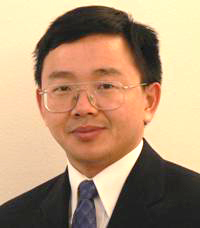 The US National Science Foundation has given a CAREER Award to Huiming Yin, alumnus (1998’) of the Department of Mechanics and Engineering Science, Peking University and now an assistant professor of Civil Engineering and Engineering Mechanics in the Fu Foundation School of Engineering and Applied Science, Columbia University, for his project "Energy in Sustainable Infrastructure - Multi-scale/physical Approach to a Novel Hybrid Solar Roofing Panel."
The CAREER Program is the NSF's most prestigious award in support of junior faculty who exemplify the role of teacher-scholars through outstanding research, excellent education, and the integration of education and research.
Yin's hybrid panel represents the next generation of solar technology, in part, because it is integrated into the building, replacing structural sheathing and roofing materials. By producing both electricity and hot water, it also merges and improves upon proven photovoltaic and thermoelectric power-generation technologies.
“The new roof panel is designed for conserving energy, harvesting solar power, recycling materials, as well as resisting various environmental deteriorations and bearing mechanical loading,” says Yin. “This technology will be applicable to new construction and renovation, and to a range of building types, from residential houses to large commercial buildings.”
This research will study physical properties of solar materials for application to roofing and will aim to fabricate a novel solar roofing panel having optimized solar/thermal/structural functions. The panel will contain a photovoltaic layer deposited on a thermoelectric layer which is then bonded to a plastic lumber substrate through an interlayer with graded properties containing water tubes. The first two layers convert both photoelectric and thermoelectric portions of solar energy into electricity.
The substrate provides mechanical support and heat insulation for the roof. The functionally graded interlayer reduces the thermal stress across the interface and controls the service temperatures of the other two layers by water flow through the tubes. The heated water is used by a hot water supply system. The heat efficiency, thermo-mechanical properties, structural integrity, and long-term performance of this novel hybrid solar roofing panel will be characterized and optimized.
Source: Fu Foundation School of Engineering and Applied Science, Columbia University