
-
[ May 21, 2014]
A new progress made in wetting on micro-structured surfaces
-
Recently, Dr. Huiling Duan’s group from Department of Mechanics and Engineering Science, College of Engineering, made important progress in wetting transition on micro-structured surfaces, in collaboration with Dr. Hao Lin from Rutgers, The State University of New Jersey. The research paper has been published in Physical Review Letters (Metastable States and Wetting Transition of Submerged Superhydrophobic Structures, Phys. Rev. Lett. 112, 196101, 2014. http://journals.aps.org/prl/abstract/10.1103/PhysRevLett.112.196101).
Structured superhydrophobic surfaces have attracted a lot of attention because of their broad applications in both engineering and sciences such as slip boundary condition, drag reduction, and flow regulation. One key mechanism to realize their functionality is to maintain on such surfaces a large area fraction of liquid-gas interfaces in the pinned Cassie-Baxter (CB) state. These interfaces, however, are subject to instabilities induced by mechanisms including vibration, evaporation, air diffusion, and impact, which are known to collapse the meniscus, leading to the fully wetted Wenzel (W) state and the failure of the surfaces in performing particular functions, e.g., drag reduction. Understanding the CB-W transition and the dynamic evolution of the metastable state is critical for the regulation and improvement of CB-based superhydrophobicity. For example, structural design can be pursued to maximize the life span of the metastable state such as to extend the longevity of the superhydrophobic functionality.
The current work examines in situ liquid-air interfaces on a submerged surface patterned with cylindrical micropores using confocal microscopy. Both the pinned Cassie-Baxter and depinned metastable states are directly observed and measured. The metastable state dynamically evolves, leading to a transition to the Wenzel state. This process is extensively quantified under different ambient pressure conditions, and the data are in good agreement with a diffusion-based model prediction. A similarity law along with a characteristic time scale is derived which governs the lifetime of the air pockets and which can be used to predict the longevity of underwater superhydrophobicity. The current work, by combining quantitative measurements with theoretical analyses, provides a better prediction of the multiphase phenomenon pertinent to structure-enabled underwater superhydrophobicity.
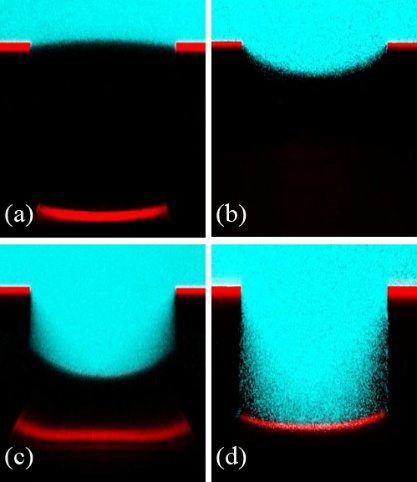
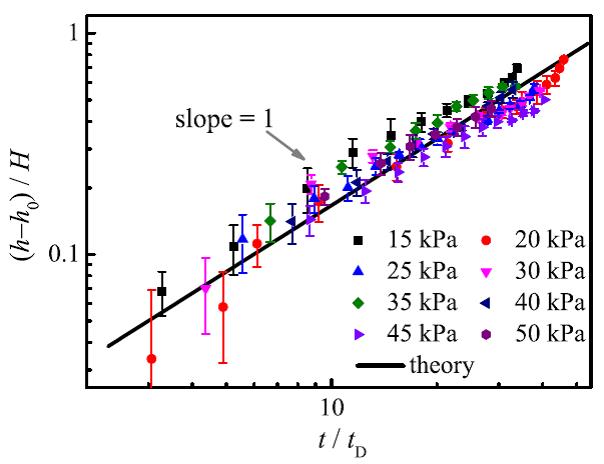
(Left: Images of various wetting states taken by confocal microscopy. Right: Comparison between theoretical and experimental results)
The first author of the paper is PhD candidate Pengyu Lv from Prof. Duan’s group. This paper is supported by National Science Foundation for Distinguished Young Scholars of China and Alexander von Humboldt Foundation in Germany under a research group linkage program.