
-
[ May 26, 2014]
New advances in the research on local mechanical properties of solid under electric and magnetic fields
-
Professor Daining Fang’s group in the Department of Aeronautics and Astronautics, College of Engineering, Peking University, achieved new advances in the mechanical properties testing, characterization method and scientific instruments for local mechanical properties of solid under electric and magnetic fields, in collaboration with Prof. Hongwei Zhao’s group at Jilin University and Prof. Haosu Luo’s group at Shanghai Institute of Ceramics. The research papers were published in Scientific Reports, Applied Physics Letters, and Review of Scientific Instruments.
Electromagnetic functional materials’ electrical, magnetic and mechanical properties can be tunable by external electric, magnetic and mechanical fields, due to its domain switching at micro- or nanoscale. In recent years, the characteristic dimensions of structures and devices are down to small scale with the development of the preparation technique of materials. Test and characterization of the local mechanical properties of materials under electric and magnetic fields are meaningful for both devices design and quality assessment.
Fang’s group, in collaboration with Prof. Hongwei Zhao’s group at Jilin University, constructed the first modularized multi-field nanoindentation apparatus for carrying out testing on materials in external magnetostatic and electrostatic fields (Maximum load: 1N; Maximum voltage: 1000V; Maximum magnetic field: 8000Oe), which can be used to investigate the electric/magnetic field induced elastic/plastic properties of ferroelectric, ferromagnetic and multiferroic materials. It can obtain the loading and unloading curves of nano-contact and nanoindentation experiments, based on which material properties can be determined.
Using the self-made multi-field nanoindentor, Prof. Fang’s group investigated the electromechanical nanoindentation behavior of relaxor ferroelectric material. It is found that electric field can significantly affect the hardness, effective modulus and energy dissipation of PMN-PT single crystal. Hardness-to-modulus ratio depends linearly with the energy dissipation. There are different effects on elastic modulus between positive and negative electric ?elds. The experimental phenomena can be explained from the perspective of free energy and the flexoelectric effect or the coupling between stress gradient and electric polarization. Based on the linear relationship between the properties discovered in experiments, a characterization method to determine the hardness and effective modulus of poled ferroelectrics is proposed.
Prof. Fang’s group has also studied the magnetomechanical nanoindentation behavior of nickel single crystal. It not also determines the local magnetomechanical coupling coefficient, but also indicates the obvious modulation of mechanical properties such as hardness, effective modulus, energy dissipation, yield stress and plastic index by the magnetic field. It is found that the small scale delta-E effect (The difference between effective modulus in presence/absence of the saturation field) is much larger than the macroscale results. One possible reason is that there is additional strain resulted from the coupling between stress gradient and magnetic domain switching, besides the traditional inelastic strain resulted from the coupling between stress itself and domain switching.
The experimental results, characterization methods and new instruments can be helpful for the design of electric/magnetic field tunable acoustical devices and their performance assessment.
Hao Zhou, a 4th year Ph.D. candidate, is the first author of the above papers. Prof. Yongmao Pei and Prof. Daining Fang are the corresponding authors. These projects are supported by National Natural Science Foundation of China and the Chinese National Programs for Scientific Instruments Research and Development.
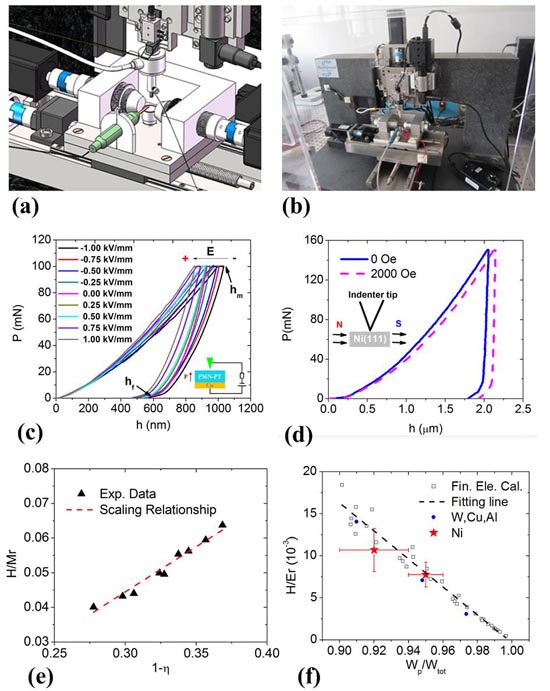
a-b:Schematic and photo of the instrument
c-d:Load-displacement curves under various electric/magnetic fields
e-f:electromechanical/magnetomechanical scaling relationship.
Links to the papers:
http://www.nature.com/srep/2014/140403/srep04583/full/srep04583.html
http://scitation.aip.org/content/aip/journal/apl/104/6/10.1063/1.4865773?ver=pdfcov
http://scitation.aip.org/content/aip/journal/rsi/84/6/10.1063/1.4811779