-
[ September 27, 2013]
COE establishes the Institute for Health Systems Engineering
-
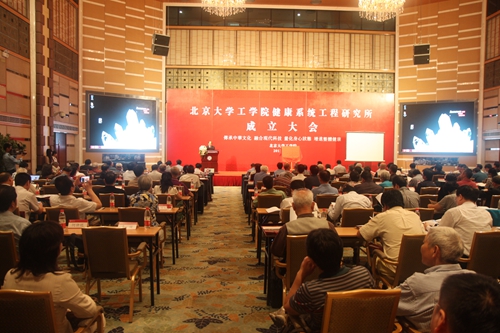
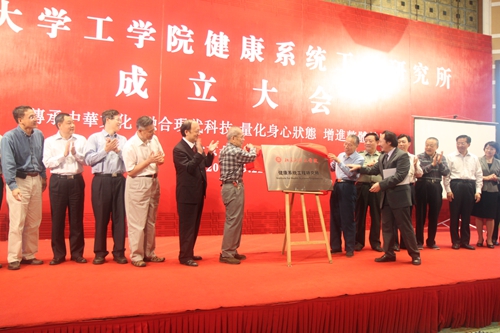
In the 21st century, all countries in the world are facing challenges of its citizens’ medical care and health. With the principle of “inheriting the Chinese culture, involving modern technology, quantifying physical and psychological status, and improving overall health”, the Institute for Health Systems Engineering of the College of Engineering (COE) was established at Peking University on September 22nd.
Over one hundred experts from government, academic institutions, hospitals, and professional societies attended the launching ceremony and expressed their congratulations. Academician Mengsun Yu from the Department of Biomedical Engineering in COE will serve as director of the institute. Professor Zhensu She from the Department of Mechanics and Engineering Science in COE is appointed executive deputy director, while Professor Qiushi Ren and Professor Zuhong Lu, both from the Department of Biomedical Engineering in COE, will serve as deputy directors.
In the lecture about the mission and directions of the institute, Yu pointed out that the current mode of medical care of focusing on treating diseases has resulted in a global health crisis. Non-contagious diseases (NCD) have become main threat to human health and life. Great economic expenses and human power have been spent on tackling NCD but with limited effect. In the long term, the increasing medical expenses for treating NCD will be too huge for any country to bear on.
Yu has studied the essence of chronic disease, and pointed out that disease is a partial reflect of the malfunctioning state of the whole body and weakening of body’s self-organizing function. He proposed that the current focus of medical attention should turn to the overall state of human body, and its self-organization function. He said that the mission of the institute is to advocate the healthy medical care mode of Sensing, Identifying and Regulating (SIR) and to promote the SIR mode to the society through the internet of things.
Professor Zhensu She said the institute has dreams to become a basement at Peking University to explore a new world of theoretical innovation, to form an information-based medical service industry for the health care needs of society, and to advance national revitalization and exchange between the east and the west.
Professor Shiyi Chen, vice president of Peking University, expressed appreciation to Yu for his contribution to the human health. He said that the health issue is of big concern home and abroad, and the institute undertakes an important role in bringing benefit to the health of human beings.
On the ceremony, it was also announced that two funds were established at Peking University to support the daily operation and research of the Institute for Health Systems Engineering, namely, the Fund for human health engineering research of Peking University Education Foundation which facilitates research projects, daily management, personnel recruiting, and the Fund for human health science research of Peking University Education Foundation which encourages technology development and application.