
-
[ August 09, 2013]
Professor Yanglong Hou’s group makes progress in the research of doped graphene as energy materials
-
Recently, the research team led by Professor Yanglong Hou from College of Engineering of Peking University has made an important progress in the synthesis of doped graphene and the application in the energy field. The results titled “Synthesis of Phosphorus-Doped Graphene and its Multifunctional Applications for Oxygen Reduction Reaction and Lithium Ion Batteries” have been published in Advanced Materials. http://onlinelibrary.wiley.com/doi/10.1002/adma.201301870/full.
Graphene is now renowned for its fascinating electronic properties and potential applications in energy conversion and storage, such as the cathodic oxygen reduction reaction of fuel cells and rechargeable lithium ion batteries. Continuous efforts have been made to fabricate doped graphene, including nitrogen-doped graphene, boron-doped graphene and sulfur-doped graphene, which exhibited good electrochemical performance in fuel cells and lithium ion batteries, or enhanced the conductivity in field effect transistors. However, synthesis of phosphorus-doped graphene still remains a challenge because of the relatively large atomic radius of phosphorus; the potential applications of phosphorus-doped graphene in energy areas have not yet been reported.
Professor Hou’s team proposed a facile, low-cost and scalable thermal annealing method for the synthesis of phosphorus-doped graphene using graphite oxide and triphenylphosphine as carbon and phosphorus sources, respectively. The resultant phosphorus-doped graphene acted as an efficient metal-free electrocatalyst in ORR, showing remarkable catalytic activity, outstanding tolerance to methanol crossover effect and excellent long-term stability. Its catalytic activity could be further improved by adding carbon black to modify its conductivity. Moreover, it was unprecedentedly employed as an anode material in lithium ion batteries, which exhibited significantly enhanced electrochemical properties in comparison to undoped graphene. The results have suggested the huge potential of phosphorus-doped graphene.
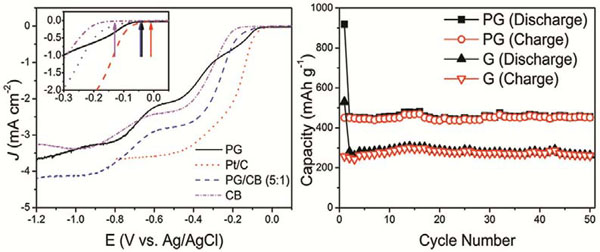
The electrochemical performances of phosphorus-doped graphene
First author of the paper Chenzhen Zhang is a master student in the Department of Materials Science and Engineering, College of Engineering. This work was supported in part by the NSFC, the National Basic Research Program of China, the Natural Science Foundation of Beijing, the Doctoral Program and New Century Talent of the Education Ministry of China, and Yok Ying Tung Foundation.
Previously, Materials Views China of Wiley Press made an exclusive interview with Professor Hou’s group, introducing their exploration of novel sulfide/graphene composites as high performance anode materials for lithium ion batteries. (http://www.materialsviewschina.com/2013/04/lithium-ion-batteries-in-the-composite/).