
-
[ August 25, 2013]
Solar Decathlon China 2013 receives positive feedback from various parties
-
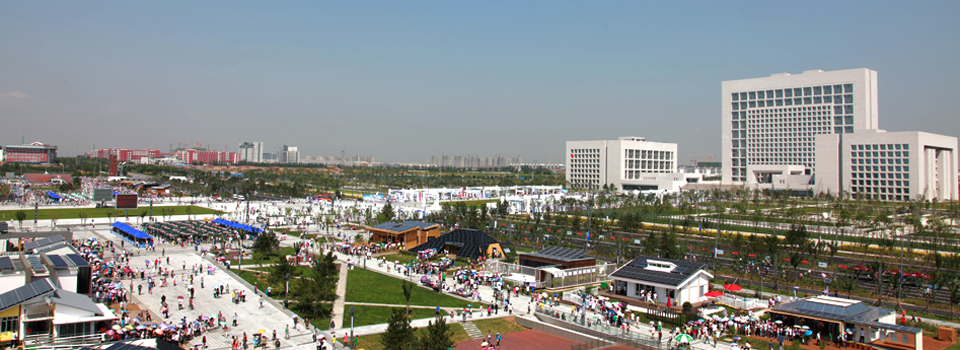
Solar Decathlon China 2013, Solar Village, Datong
From August 2- 11, the Solar Decathlon China (SDC) 2013, a biannual competition of the US Department of Energy which challenges collegiate students to design, build and operate solar-powered houses was successfully held in Datong, Shanxi Province. 35 universities from 4 continents participated in the event, making it the most international Solar Decathlon ever.
During the competition, about 250,000 people visited the houses to sense the beauty of delicate blending of advanced energy-saving technology with architecture. The event also attracted enormous media attention. Many mainstream media such as Sina, China Daily, and Renmin News Agency covered the news as well as the local media in Datong.
“It’s the first time that SD took place in Asia, and Peking University (PKU) was honored to undertake the event,” said PKU Vice President Yansong Li on the closing ceremony.
The College of Engineering (COE) has fully supported the launch and organizing of the event. Early in 2011, Dean Dongxiao Zhang was in contact with the US Department of Energy and helped make the event happen in China. Professor PR Yu of the Department of Energy and Resources Engineering of COE took the responsibility as director of the organizing committee. Associate Professor Hao Wang of the same department served as one of the three jury members of Engineering Contest.
When the event concluded, we interviewed many people from various sides, and they all gave favorable feedback on the event.
I. PKU students: “I learned a lot from the experience.”
SDC challenges collegiate teams to design, build and operate solar-powered houses that are cost-effective, energy-efficient and attractive. All the teams must create a solar-powered house that are fully functional, comfortable and equipped with advanced energy-efficiency technologies. PKU students from several majors worked together with University of Illinois students for two years, before successfully building a 97-square-meter two-bedroom solar house named “Etho”.
The energy Etho collects with solar panels could satisfy all the electricity needs in a common family’s daily life, including lighting, cooking, washing, and home entertainment. The house has a temperature and humidity monitoring system which ensures a comfortable living. In addition, the team developed a remote-control system which can be installed in computer and mobile phone to control lighting, air conditioner, windows and even household appliance. Though Etho didn’t participate in the contest, it received huge attention from the public.
“The experience benefited me a lot. In the past two years, we collaborated closely with the COE faculty and our U.S. teammates and gradually made our idea come true. In the process we overcame many difficulties,” said COE student Yiming Liu, “For instance, the total cost of Etho is over 3 million yuan, of which the SDC organizing committee provided less than 1 million. To fill the funding gap, our advisor Professor Dong Wang helped us contact many companies to seek sponsorship, and I learned a lot about pitching and convincing others. Second, each aspect of Etho involves efforts from two schools, which calls for close collaboration with the foreign students. We have to communicate a lot through emails and skype and learn how to deal with differences of opinions.”
II. Runner-up Team South China University of Technology (SCUT), “It’s a pleasant surprise.”
Team SCUT consists of a number of students and faculties from South China University of Technology. All the members of the student group are graduate students and senior undergraduates, who come from School of Architecture, School of Mechanical Engineering, School of Energy and Power Engineering, School of Civil Engineering, etc. Their house “Concave” is designed with concept of saving, comfort, unitization and technology. The house won second place in the overall contest, and highest score in the individual contests of Market Appeal, Appliance, Home Entertainment, and Energy Balance. It’s the only team from China that enters the top three.
Joyce Mason, Jury of Market Appeal and Vice President of Marketing for Pardee Homes, introduced Concave in the following words, “The experience of this teams’ holistic approach to designing a traditional Chinese home with sustainable technologies was transformative. It begins as you enter the walkway and go by the beautiful vegetable garden lined with blooming sunflowers. The kitchen has well placed with very functional cabinetry and the task lighting delights the user by using a hand wave to turn it on. The fish pond at the center of the home combines a very traditional element with sustainability as it cools the breezes that enter the home in the summer and converts to a sunroom in the winter to distribute heat and offers light and nature from nearly every space. The entertainment possibilities of this home and the ease of using the controls, as well as the large bedroom will be good for the senior client. We were also impressed by the modular building design and the ease of building this home. The sustainable technologies are integrated and add to the quality of life without being imposing while at the same time traditional themes are present at every level.”
SCUT member Yiyang Yu who majors in architecture and takes care of the marketability of the house said, ”We are thrilled to know the results. It’s a pleasant surprise. We spent two years in total, with the first year working on improving the design and the second year in building. During the process we met many difficulties but we are brave and very united. Some of our members are really talented in some respects, like graphic design and App development. ”
III. City of Datong: A gold opportunity to promote economic transformation
Datong is the second largest city in Shanxi Province with a population of 3.6 million. It was once known as the Capital of Coal for its rich resources of coal. In recent years, it has been carrying out a strategy of transforming from fossil industry to new energy such as wind and solar. With annual average hours of daylight reaching 2800 hours, Datong has an exclusive advantage in developing solar industry. So when SDC invited bidding for the undertaking city in 2011, Datong regarded it as a gold opportunity to promote its new energy development. It finally won the undertaking right over competitive cities including Suzhou in Jiangsu Province and Hangzhou in Zhejiang Province.
Datong invested 1.36 billion yuan to build a 23-storey manifest building named “solar palace” in the Yudong New District. The well-equipped building has many functions including conference rooms, auditorium, hotels and restaurants. A huge square in front of solar palace provides sufficient room for the building of SDC solar houses as well as public visit. During the competition, four new bus routes were open to solar palace so that visitors can get to the site more easily.
When the solar houses were open for public visit during August 3-13, about 250,000 Datong citizens visited the houses. For them, it’s the first time that a major international event took place in their hometown, and they were eager to see the houses. Many parents brought kids with them. They commented that the houses broadened their visions and enhanced their understanding about energy saving and environment protection.
VI. Summary
Richard King, employee of the U.S. Department of Energy (DOE) who created the Solar Decathlon in 2000 and directed the 2002, 2005, 2007, 2009 and 2011 events, witnessed the SDC 2013 all the way. He said when SDC concluded, “As a proud employee of the U.S. Department of Energy, I couldn’t be happier. We nurtured this event in America, watched it grow in Europe, and witnessed it reach new heights here in China. I am overwhelmed with gratitude and emotion.”
Professor PR Yu mentioned in his closing speech that the significance of SDC may lie not only in the competition itself, but far more in areas of student cultivation, international cooperation, public education, impact on Datong and the potential influence on the solar industry. Our interview with the many participants including decathletes, visitors, local governmental officials and the participating organizations revealed that SDC 2013 is a successful international event with substantial influence in university, industry and public education.
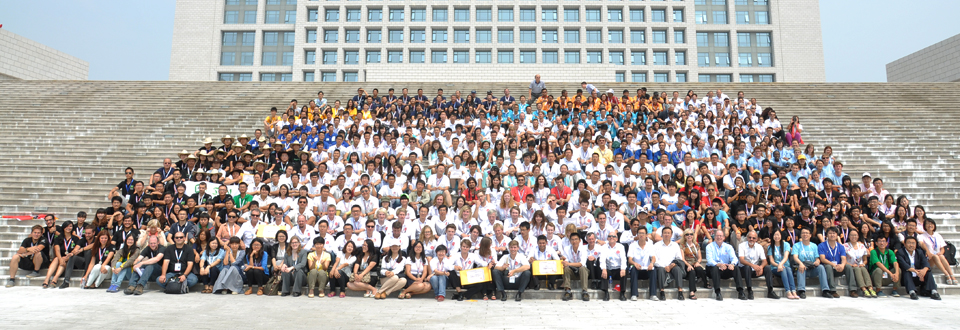
All SDC decathletes