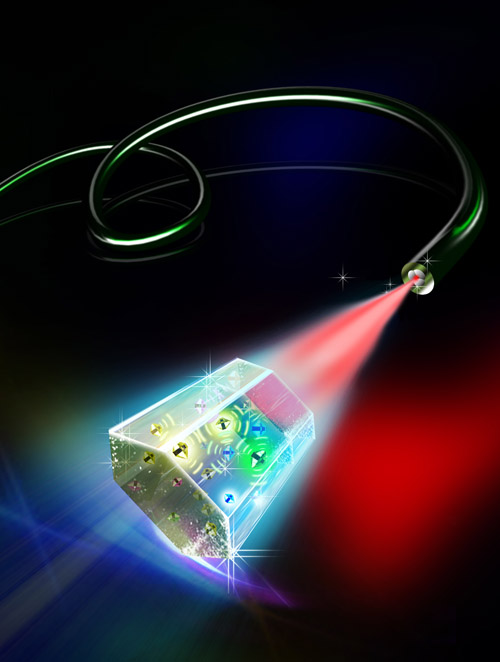
 As a result of a long-term Australia-China collaboration, researchers have made a breakthrough discovery in identifying the world's most sensitive nanoparticle, opening up opportunities of single particle sensing. These super-bright, photostable and background-free nanocrystals enable a broad range of advanced biotechnology and nanotechnology applications, such as tracing low abundant biomolecules and interactions, diagnosing residual cancer cells, and deep-tissue imaging of tissues.
Published in Nature Nanotechnology on 1st Sept., 2013 (
http://www.nature.com/nnano/journal/vaop/ncurrent/pdf/nnano.2013.171.pdf
), the research outlines a new approach for nanoscale sensing by bringing together a specific form of nanocrystal, called "SuperDot" with a special kind of optical fibre that enables light to interact with tiny (nanoscale) volumes of liquid.
“For the past decades, the upconversion properties of rare-earth nanoparticles are limited to low efficiency caused by the limited number of emitters per nanoparticle, because it was widely accepted that high concentration of emitters would lead to luminescence brightness quenching. The nanophotonics team has broken this myth through highly focused light excitation, which enables thousands of emitters enriched per nanocrystal, so that detection of a single SuperDot remotely by a fibre becomes real, a sensitivity enhancement by over three 3 orders of magnitude comparing with that of benchmark Quantum Dots.” explains Peng Xi, Associate Professor in the Department of Biomedical Engineering, College of Engineering, Peking University.
“These SuperDots are excited with infra-red light – and infrared can penetrate deep into the tissue. Together with its super-brightness, it can open up many opportunities that conventional fluorescent labels are too weak to reach.”
The performance of sensing at single molecular level had previously been limited by both insufficient signal strength and interference from background noise. "Material scientists have faced a huge challenge in increasing the brightness of nanocrystals," says Dr. Dayong Jin, Senior Lecturer and ARC Fellow directing the Macquarie University's Advanced Cytometry Laboratories. "Using these optical fibres, however, we have been given unprecedented insight into the light emissions. Now, thousands of emitters can be incorporated into a single SuperDot - creating a far brighter, and more easily detectable nanocrystal."
Under infrared illumination, these SuperDots selectively produce bright blue, red and infrared light, with a staggering thousand times more sensitivity than existing materials. "Neither the glass of the optical fibre nor other background biological molecules respond to infrared, so that removed the background signal issue. By exciting these SuperDots we were able to lower the detection limit to the ultimate level - a single nanoparticle," says Jin.
"The trans-disciplinary research from multiple institutions has paved the way for this innovative discovery," says Jin, "with the interface of experts in nanomaterials, photonics engineering, and biomolecular frontiers."
"These joint efforts will ultimately benefit patients around the world - for example, our industry partners Minomic International Ltd and Patrys Ltd are developing uses for SuperDots in cancer diagnostic kits, detecting incredibly low numbers of biomarkers within conditions like prostate and multiple myeloma cancer."
"Up until now, measuring a single nanoparticle would have required placing it inside a very bulky and expensive microscope," says Professor Tanya Monro, Director of the University of Adelaide's Institute for Photonics and Advanced Sensing (IPAS) and ARC Australian Laureate Fellow. "For the first time, we've been able to detect a single nanoparticle at one end of an optical fibre from the other end. That opens up all sorts of possibilities in sensing."
"Using optical fibres we can get to many places such as inside the living human brain, next to a developing embryo, or within an artery - locations that are inaccessible to conventional measurement tools.”
"This advance ultimately paves the way to breakthroughs in medical treatment. For example, measuring a cell's reaction in real time to a cancer drug means doctors could tell at the time treatment is being delivered whether or not a person is responding to the therapy."
The team of researchers is now actively seeking other industrial partners with the capacity to jointly develop solutions outside of these fields.
***
Publication: Single-nanocrystal sensitivity achieved by enhanced upconversion luminescence. Jiangbo Zhao, Dayong Jin, Erik P. Schartner, Yiqing Lu, Yujia Liu, Andrei V. Zvyagin, Lixin Zhang, Judith M. Dawes, Peng Xi, James A. Piper, Ewa M. Goldys, Tanya M. Monro. Nature Nanotechnology (2013):http://www.nature.com/nnano/journal/vaop/ncurrent/full/nnano.2013.171.html