
-
[ March 06, 2013]
Associate Professor Jue Zhang’s collaborative research published on PNAS
-
Recently, Associate Professor Jue Zhang of the College of Engineering, Peking University published his research progress on cell mitochondria communication in Proceedings of the National Academy of Sciences of the United States of America (PNAS). The paper was entitled "Kissing and nanotunneling mediate intermitochondrial communication in the heart” (http://www.pnas.org/content/early/2013/02/05/1300741110.long). Zhang’s collaborators include researchers from Institute of Molecular Medicine, Peking University, Institute of Biophysics, Chinese Academy of Sciences and Department of Cell and Developmental Biology, University of Pennsylvania Medical School.
Mitochondria are unique organelles in eukaryotic cells. It is both the center of the energy metabolism of cells and the transduction hub for Reactive oxygen species (ROS), survival and apoptosis signal. The dysfunctions of mitochondrial energy metabolism and signal are closely associated with cardiovascular disease, cancer, diabetes and other serious diseases.
Each animal cell contains hundreds of mitochondria which evolved endosymbioticly from independently living ancient bacteria being engulfed by ancient cells. Mitochondria are highly dynamic. They exchange substances and signals through Fusion-Fission when meeting each other to maintain mitochondrial group homogeneity and normal function.Each cardiomyocyte contains approximately 6000 mitochondria. However, the lattice-like arrangement of myofilaments limits mitochondrial movement, making it difficult for Fusion-Fission. So the question is whether mitochondria in adult cardiomyocyte communicate with each other dynamically. And if yes, how to achieve it?
Using mitochondria-targeted expression of photoactivatable green fluorescent protein (PAGFP) in conjunction with confocal microscopy, the research team investigated mitochondrial dynamics in living adult rat cardiomyocytes over extended periods of time.
They found that mitochondria communicate with each other, with the elemental steps manifesting as discrete, sudden content transfer events between adjacent (“kissing”) or long-range mitochondrial pairs (“nanotunneling”).
As a result, the entire population of mitochondria forms one dynamically continuous network, such that the membranous or matrix contents of individual mitochondria mix and exchange over the whole cardiomyocyte on a timescale of ~10 h.
Preliminary tests also showed that, the mitochondrial nanotunneling and kissing mechanism undergoes obvious subside in heart failure. In addition, nanotunneling is approved prevalent in a variety of other cells, coexistent to the classical Fusion-Fission mechanism.
This work reveals a new mode for mitochondrial substance exchange and communication that is different from Fusion-Fission. This work was supported by 973 Program Grants 2013CB531203 and 2011CB809102; National Science Foundation of China Grants 30971062, 31130067, and 31221002; and National Institutes of Health Grant R01 HL 48093 (to C.F.-A.).
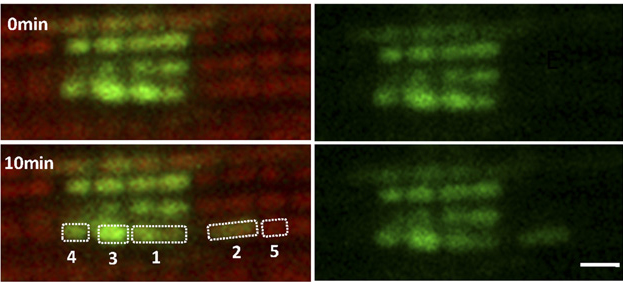
Kissing between a pair of adjacent mitochondria.