
-
[ March 13, 2012]
Research team leads major breakthrough in bioaerosol inactivation using non-thermal plasma
-
Recently, a research team co-led by Maosheng Yao, a researcher at Peking University College of Environmental Science and Engineering, and Jue Zhang, an associate professor from the College of Engineering, achieved a major breakthrough in bioaerosol inactivation using non-thermal plasma.
Their paper, “Rapid Inactivation of Biological Species in the Air using Atmospheric Pressure Non-thermal Plasma,” was published in Environment Science and Technology.(ES&T)
http://pubs.acs.org/doi/abs/10.1021/es203770q
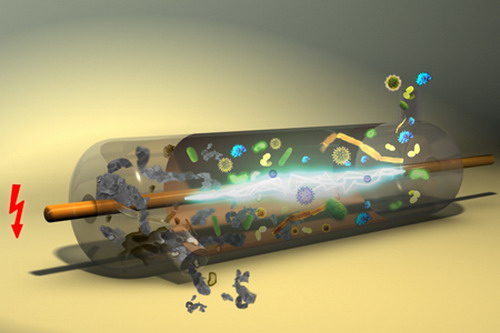
Non-thermal plasma inactivated biological aerosol
Airborne biological particles are ubiquitous in the environment; they include a variety of microorganisms (bacteria, fungi, and viruses), allergens, plant debris, endotoxin, glucans and skin scales. Exposure to those pathogenic microbes or derivatives is shown to cause numerous adverse health effects. The outbreaks of SARS in 2003 and influenza H1N1 viral infections in 2009 prompted global attention on effective biological monitoring and control measures. There are at least 1,800 bacterial types of environmental bioaerosols and some of them are of bioterrorism significance.Over the past decades, different types of technologies have been investigated for inactivation of biological agents, including traditional filter membrane, ultraviolet and microwave radiation, but the inactivation rate remains to be a great challenge.
Peking University researchers generated non-thermal plasma (the “Fourth State of Matter” that is electric neutrality, which contains atoms that are partly deprived of electron and ionized gas that is ionized from atom) using their self-designed DBD system, and inactivated bacteria and fungi with remarkable high efficiency within milliseconds of treatment.
Research shows that most of the bacteria break into pieces when the air with different kinds of bacteria passes through the non-thermal plasma generating system, an inactivate rate of more than 98% for B. subtilis, which is believed to be very resistant to the environmental stress and are often used as a surrogate for anthrax. The bioaerosol exposure to the non-thermal plasma causes not only inactivation, but also cell wall and DNA damage. Moreover, research shows that non-thermal plasma has a good removal rate for chemical species such as HC and NO.
The non-thermal plasma has potential for wide applications for air sterilization in hospitals, high value buildings, military bases, flight cabins and other public health facilities.
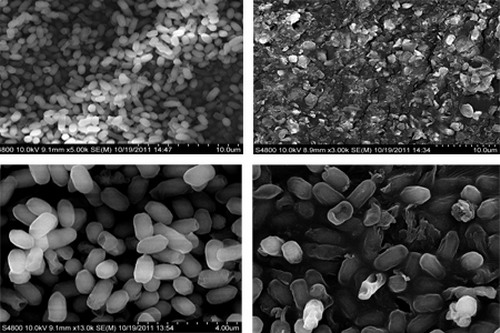
Scanning Electron Microscopy (SEM) images of control and plasma-treated B. subtilis samples
Zhang and Yao are co-corresponding authors of this paper. Yongdong Liang, a COE Ph.D. student, and Yan Wu, a College of Environmental Sciences and Engineering Ph.D., are co-first authors of the paper.This research embodies the characteristics of interdisciplinary research. Other authors included Professor Tong Zhu of the Peking University Environment and Health Center, Professor Jing Fang of the Academy for Advanced Interdisciplinary Studies and graduate students Ke Sun, Qi Chen, and Fangxia Shen.